Casting Directors:
Valeriia Ruban & Sofi Pashkual
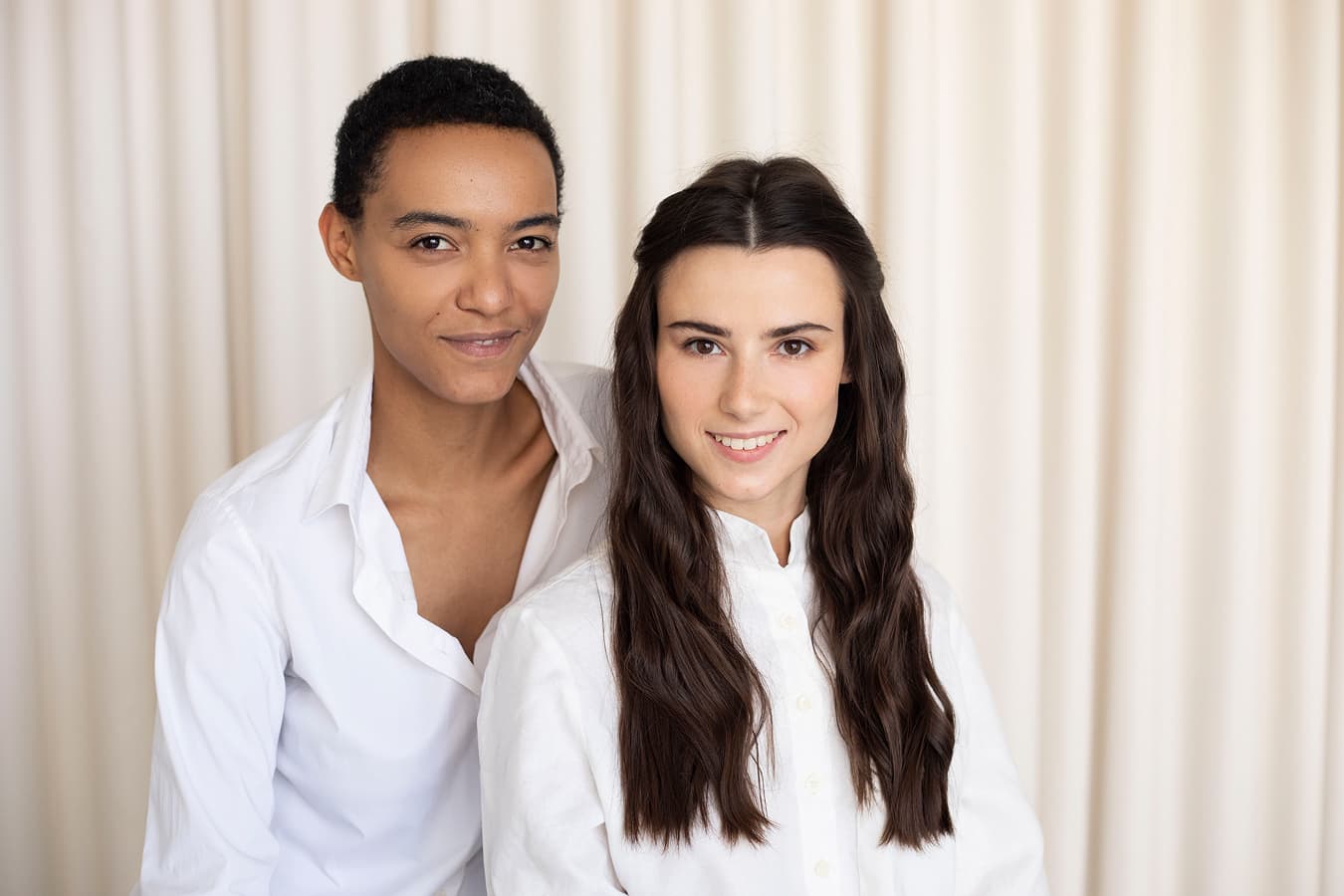
-
– How did you come to the profession of a casting director?
Sofi: It all started when I was working as an actress, and my friend, who was a producer at the time, was working on a project for a young artist. She asked me for help — to recommend some actors because I knew a lot of them. This turned into something resembling casting from my side. And to this day, I consider it one of the most magical jobs, even though it was my first. I remember that project with warmth. The producer really liked my work and invited me to do the casting for another project. That was in 2017, and things took off from there.
Valeriia: I came into this profession around 2016 as an actress. It was either the summer of 2015 or 2016. Daria Plakhtiy literally took me by the hand to Alla Samoylenko’s office. Alla was casting for the project My Favorite Teacher, which I successfully auditioned for. That’s how we met. Later, when there wasn’t much acting work, Alla suggested I help with casting. I agreed. I worked with Alla for about two years — it was an immense experience, top projects, 24/7 work. It was amazing. I still believe I was very lucky — I ended up in the best place, next to a true professional. Later, I began working independently.
-
– How did you start working together?
Valeriia: We used to help each other out with castings. Sofi would reach out to me, and I to her. At one point, we met up and realized that Sofi was looking for a partner for her newly established agency, and she offered me to join her. I gladly agreed. Our young but promising casting agency is called BIMBA Casting, and it’s now two years old.
-
– – Do you work mostly within Ukraine?
Sofi: Yes, so far all the productions have been Ukrainian. We haven’t collaborated internationally yet.
Valeriia: But right now, we’re working on a short film with an American director of Ukrainian origin, Gleb Osatinsky. He won a grant from Columbia University and wants to work with Ukrainian actors. This is our first international project under the BIMBA Casting banner. Before BIMBA, I often worked with international collaborators — for example, with French photographer Fred Jeghno on a major photo project, and I also helped as a coach and translator for the film Anna by Dekel Berenson.
Sofi: We still work with international projects via Ukrainian productions, not directly. Before Valeriia joined, I worked a few times with Radioactive under Niki Bondar’s management — a completely different world and a complex casting and production system. I also worked with MOZGI Production, SICK, 23/32, and others.
Valeriia: I’d also like to mention our projects. We’ve reached a new level recently! In the winter, we shot a pilot for Novyi Kanal (New Channel). We really wanted this — and we made it happen. For some casting directors, this might be routine, but we’re thrilled. Right now, we’re finishing a big project for Auchan, in a format that’s new to Ukraine.
-
– How can actors get into your database?
Valeriia: We don’t really have a formal database. We’re working on it, but honestly — each project is like an ocean: we dive in and look for actors through various sources — Facebook, our contacts, Instagram, even on the street.
Sofi: Especially in advertising and music videos, we work with many nonprofessional actors or even people outside the profession. For example, we’ve looked for golfers, farmers, dancers — real people. I’d add that we have an improvised database — actors we work with frequently. How to get in? Write to us on Facebook, Instagram, or email.
Valeriia: Be sure to include a few good photos that clearly show your face. This is repeated all the time, but many actors still don’t have high-quality, marketable photos. We value professionalism. A video intro doesn’t have to be super polished — what matters most is to show the person’s natural presence: facial expressions, gestures, personality. That’s very important.
-
– Can you describe the actor approval stages for a role?
Sofi: Actor approval varies from project to project. In very small projects, decisions can be made in minutes just by looking at photos. In larger projects, especially advertising or foreign productions, there are a few options: we may start with live castings, without even reviewing photos first, and see a large number of people. Since COVID-19, live castings have become rare, and I’m not sure they’ll come back.
-
– What are the stages of a big casting process?
Sofi: It might start with a live audition or a pre-casting phase using photos and video intros. Then, depending on the project, there may be a callback with the director or a round of self-tapes first. After a callback, there may be confirmation or another callback. It all depends on the production. Usually, it all starts with photos and video intros. We haven’t done fully blind live castings in a while. There were cases where we invited actors we didn’t know based on photos, but in real life they looked so different we didn’t know how to shoot them. Not because they weren’t attractive, but because their real-life look didn’t match their type in the photos, so they didn’t fit the project.
Valeriia: Sometimes we have to reject such people or speak harshly because this is a profession, and you need to respect others’ time and effort. It’s important to be professional and treat others with respect. That’s why actors should use realistic, up-to-date photos — so they don’t leave a bad impression. A casting director is much more likely to work with someone who understands these nuances than with an actor who misrepresents themselves or doesn’t understand basic portfolio etiquette. Of course, sometimes you can find a perfect character from a Facebook profile photo with a fish, but that’s another story.
-
– You were both actresses before becoming casting directors. How has that changed your view of the acting profession?
Valeriia: I don’t think my perception changed. Your acting and filmmaking talent just expands, and as a casting director you develop organizational and directing skills — the ability to see the bigger picture, the thrill of discovery, love for faces and human nature.
Sofi: I believe that casting experience adds to your acting skills because you understand the internal workings of the process, which helps you adapt better. Since most actors in Ukraine work without agents, it’s crucial to understand how the system works. And conversely, acting experience helps in casting — you’re constantly meeting new people and always in touch with the community.
Valeriia: The film industry in Ukraine is growing so rapidly that anyone can become a casting director or agent now. Of course, professional level requires experience, but it’s relatively easy to gain that if you’re motivated. Communication skills are essential.
-
– Do you have a blacklist?
Sofi: We do, although we don’t keep a literal list — we just remember everyone.
Valeriia: Unprofessional behavior is always memorable.
-
– Have you ever encountered unprofessionalism?
Sofi: Yes, for example, regarding shoot dates. Some actors agree to certain dates and then later say they’re unavailable. Or they say they can work, but not the whole day. It’s important to be upfront about your availability. As an actress, I now understand the production process from the inside. Especially in commercials, the schedule often isn’t finalized until the very last minute. That’s normal — we may only get the day’s plan a day in advance. We always tell actors that even if you’ll only be needed for a short time, you must keep the whole day free, in case of delays or changes. Once we had a shoot where complicated sets were involved, and actors were booked for two days just in case repairs were needed mid-shoot. It’s a very demanding process.
Valeriia: If you’re demanding as an actor, you must match that with your professionalism. Every department gives 100%, and there are always unpredictable things in filming. We don’t have a full-fledged film institute yet, so you learn on the job. Some people learn from mistakes, others don’t — and those who don’t, end up on the blacklist. But the good part is you can start working on set right away and gain experience — it’s very accessible.
-
– Where are you from originally?
Sofi: Valeriia and I are both from Donetsk. We sort of pulled each other in.
-
– What did you dream of being as a child?
Sofi: I loved fish as a child, so I dreamed of selling sprats at the market. My mom went to the market every Saturday and bought me sprats. I thought she worked there, so I wanted to be like her. Turns out, she didn’t work there at all.
Valeriia: I used to gather my family in the evenings, turn off the lights, turn on a desk lamp, point it at myself, and perform magic tricks. I also wanted to be a vet.
-
– If you were an object, what would you be?
Sofi: I associate myself with a pen. I’m not sure why — that just came to mind.
Valeriia: Never thought about it. Maybe a cool sports car — like a Ferrari or Lamborghini. That’s the first thing that popped into my head.
Sofi: I think you’re an orchid!
Valeriia: An orchid? That’s not bad either.
-
– Imagine you caught a goldfish. What three wishes would you make?
Sofi: I might sound materialistic, but I’d wish for a lot of money. Honestly, I feel I have everything else. Not counting global wishes like world peace, no hunger or disease — which I find unrealistic — my second wish would be for a world without borders, so people could travel freely. And third — that people would stop harming animals.
Valeriia: I’d wish for either a lot of money or the opportunity to direct my own film without having to limit myself. My second wish is personal — to have my family close. Unfortunately, part of my family still lives in Donetsk, and I can’t bring them here. So I’d wish for all of us to live nearby. Third — also about animals: to stop killing elephants, to preserve nature. Maybe I’d also ask that Kyiv stop being overbuilt — soon we’ll suffocate here.
-
– What project would you love to work on as casting directors?
Valeriia: Some amazing, high-quality indie film or a massive Hollywood production. And I’d love to create a film or series that gives Ukraine a true hero — like Sherlock, Dr. House, or a fantasy superhero. Our audience needs more inspiration and entertainment through cinema.
Sofi: Yes, to discover someone — I think that’s every casting director’s dream: to find a person no one knew before and make them recognized and in demand. I’d also love to be part of a quality series, like The Marvelous Mrs. Maisel.
-
– If you had a superpower, what would it be?
Sofi: Controlling time.
Valeriia: I already read minds (laughs). Maybe I’d want to control an element, like a natural force.
-
– What are your hobbies?
Sofi: I recently started playing badminton, and I’m learning languages — English and Portuguese.
Valeriia: I have many hobbies, and I want to return to photography. But my biggest passion is music.
-
– What would you wish and advise to actors?
Sofi: I wish us all — actors and casting directors — great projects! My advice: work hard. I know many feel discouraged because our industry isn’t yet big enough for everyone to have great roles and consistent work. But it’s still important to invest in yourself, keep developing, learn languages, and update your portfolio. You may need another profession to support yourself financially and keep up your materials and training. You don’t have to work in retail — many actors work in production. Valeriia and I did too — we started as assistants on set. Valeriia even worked as a clapper loader and acted in The Sniffer – Season 3.
Valeriia: Being a clapper loader is the foundation. Even if you’re not involved in preproduction, you learn a lot on set — about departments, how people work, how the camera sees things. I’d wish actors fulfillment — because unfulfilled actors often cause problems. Always study your craft, discover new things in yourself and in the profession. Respect everyone involved in filmmaking — it will bring you good karma (laughs). We all have one mission — to make films. Be adequate. Assess yourself realistically: know what you can play and what you shouldn’t try yet — to avoid rejection or frustration. And never lose hope — you are seen, more than you think.
Sofi: If you work hard, you will be noticed — even if you’re not the most talented. Talent is a very subjective concept. So if you consider yourself an average actor but keep growing — you can achieve a lot.