Casting Director: Olga Klimenko
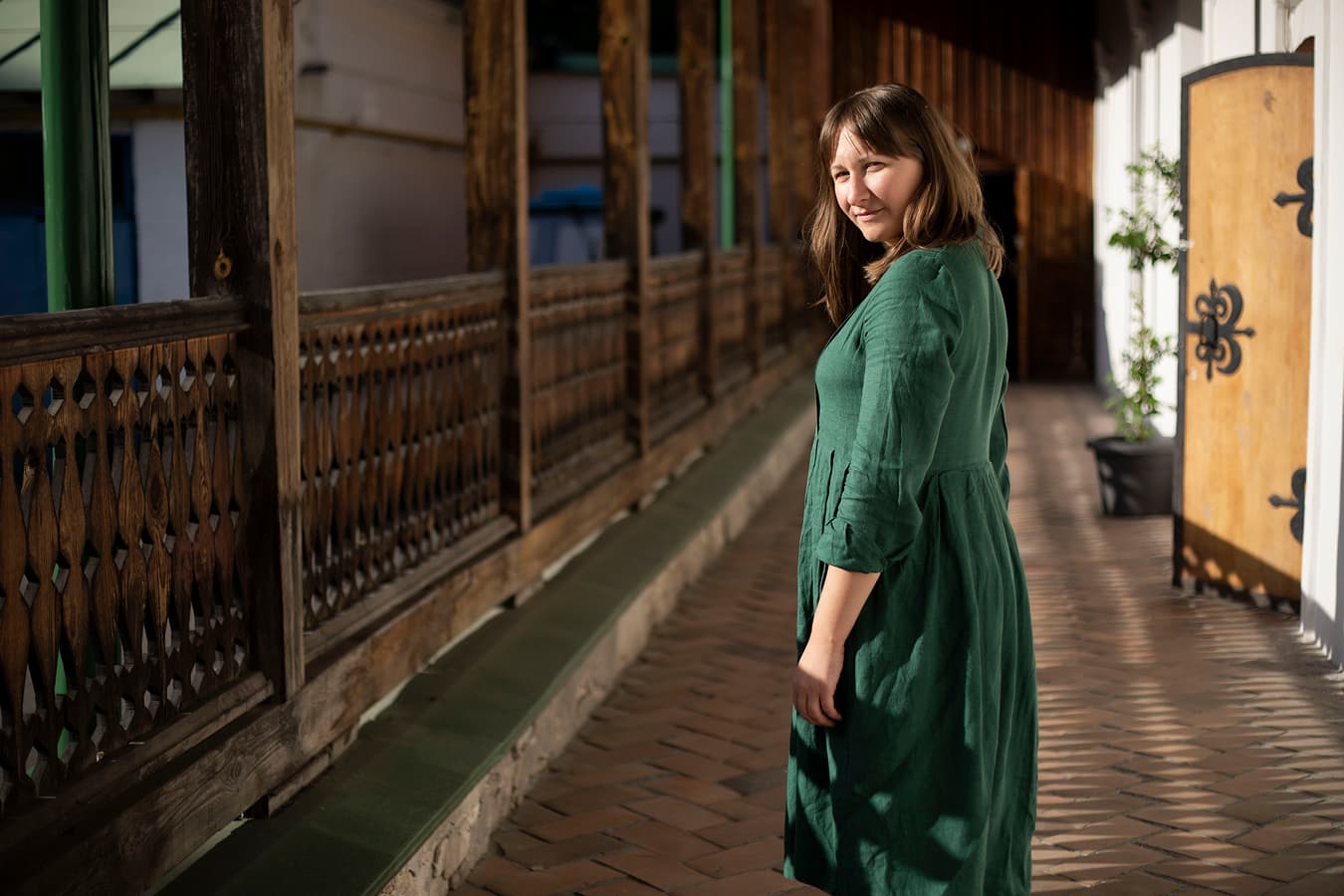
-
- How did you come into this profession, and how long have you been in it?
- You know (let’s switch to “you”?), this is my favorite question in your interviews! It’s fascinating to read colleagues’ stories about their paths into this profession. Each one is so different. Mine began in 2008. At the time, I was studying for a master’s degree in law at Shevchenko University and working as a notary’s assistant. We had a wide variety of clients at the notary office. Some were buying apartments, others getting married, divorced, or moving abroad. I felt that these people were living full, interesting lives, while I was merely observing their stories, helping to formalize contracts, powers of attorney, and marriage agreements. Around that time, I became deeply interested in theater and found myself more engaged in discussing the latest premiere at “Atelier 16” than in studying the Instruction on Notarial Acts.
Do you know what helped me overcome this personal crisis? Envy! Our notary office was located near the Theater University, and I often adjusted my route to work to pass by the university. Students would always hang out near the entrance. They seemed so interesting and uninhibited to me. They didn’t just attend theater performances like I did by buying a ticket at the box office; they were part of the process. I would watch them and feel envious. Envy is a great diagnostic tool. It helps you understand your desires, even those you might not admit to yourself. The following year, I was already studying at the Department of Theater Organization at the Karpenko-Kary University
At Karpenko, I loved everything: the atmosphere, the old wooden table in the corridor of the building on Khreshchatyk, the history of theater, theater criticism, and my new friends. We constantly read, attended theater performances almost every evening, and spoke in quotes from our favorite plays. It was such a wonderful period! Cinema wasn’t in my plans at all. At that time, I only dreamed about theater. But even then, I wondered: why are there so many good actors in Ukraine, yet we see only a few of them on screen?
Then, a fateful meeting occurred—Ivanna Anatoliivna Dyadyura (producer of “Cyborgs,” “Catch Kaidash,” “We Are… We Are Nearby”) came to our department. Thanks to her, I first got on a film set and later into casting.
In 2010, Ivanna Anatoliivna was looking for student interns for the Kyiv shooting period of “The White Guard” directed by Sergey Snezhkin. I passed the interview with Ivanna, but she didn’t want to take me on set. I followed her around for about two weeks, asking to be taken to the film set. She refused, saying that working outside in -20°C wasn’t suitable for a girl. I tried to convince her that I loved Bulgakov (he was my favorite writer at the time), but she didn’t take it seriously and thought I was just a girl wanting to see Khabensky up close. I’m not sure I would show such persistence now if someone told me “no.” But back then, they did take me on set. And I didn’t like it at all! It seemed chaotic to me. It was like an anthill: many people running around, doing unclear things, and sometimes shouting. Now, knowing how things are organized in cinema, I understand that this “anthill” is actually well-organized, and everyone knows exactly what they’re doing. But at the time, I thought, “God, no, I want to go back to the theater!”
So, Ivanna Anatoliivna is, without exaggeration, my godmother in cinema, where, thanks to her, I’ve been working for eight years.
-
- What is your favorite project?
- Each one. I love what I do at all stages. I love the excitement before the first reading of a new script. I love discovering actors for myself, for the director, and for the audience. I love when an ensemble begins to crystallize from a chaos of thoughts and options. I love being satisfied with the result of my work and especially when the director likes the outcome of our collaboration. I love going to the film set and, standing at the playback monitor behind the director, seeing that he is pleased with the actors’ performances. I love premieres with their festive atmosphere and light euphoria when the whole team gathers again and receives the first feedback from the audience.
МIt may sound pretentious, but each of my projects is important to me; each had some new experience, interesting challenges, and something special. I have a tradition of celebrating the first approval in a project. But, for example, in “Cyborgs,” I celebrated the last one. We couldn’t find Serpen for a long time. We tried good actors, but there wasn’t that precise match. And when, the morning after Slava Dovzhenko’s audition, Ivanna Anatoliivna called me and said, “It’s him!” I remember dancing in the kitchen. I’m happy and proud that we introduced Viktor Petrovych Zhdanov to the audience in this film. I think his collection of awards won’t be limited to the two existing Dziga awards. Viktor Petrovych is an incredibly organic and multifaceted actor. I love our entire ensemble in “Cyborgs.” And I love working with Akhtem. Akhtem Shevketovych is a special director for me; we’ve worked together on six projects. I first saw him during my pre-theater era on the stage of the Russian Drama Theater. It was the play “The Testament of a Chaste Woman,” where he performed with Mykola Rushkovskyi and Natalia Dolia. Later, as a theater student, I saw him in “Romeo and Juliet” by Lisovets at the Left Bank Theater. He had a very cool role there. When we started working together, I initially felt inhibited because this was someone I had admired from afar, and now, suddenly, I was working with him! An interesting experience was casting for another of our joint projects—“Zakhar Berkut.”
We organized a large-scale casting tour. With Nastya Chorna (casting manager of “Zakhar Berkut”), we visited eleven universities in seven cities of Ukraine. In some cities, up to a hundred people came; after such castings, it’s hard to even make it back to the hotel. It was strange and unpleasant to later read comments suggesting that we deceitfully and cynically deceived young Ukrainian actors by initially giving them hope and then casting Americans for those roles. It was a very exhausting casting tour, but it was worth it; the interesting actors we found then have already appeared in more than one of our projects. For example, during this casting, we found Daryna Fedyna, who played Melashka in “Catch Kaidash.”
“Catch Kaidash” was a kind of professional happiness. I remember stretching out the reading of the last two episodes because I didn’t want the script to end. I’m incredibly grateful to Natalka Vorozhbyt and Oleksandr Timenko for this work. Our auditions were very fun. Nina Naboka was approved immediately after her audition. She said it was her birthday, and Sasha and Natalka looked at each other and said in unison, “Congratulations! You’re approved!” I’m very, very happy that there was a good role for Liubov Stepanivna Kolesnikova in “Kaidash.” I met Liuba Stepanivna when I did casting for “Steppe” by Maryna Vroda a few years ago, and in “Kaidash,” I finally had the opportunity to introduce actress Kolesnikova to a wider audience. Her Baba Palazhka probably became one of the most beloved characters.
Working on “Steppe” by Maryna Vroda was challenging but interesting. Maryna introduced us to the world of auteur cinema, where casting has its own peculiarities. Initially, I was puzzled about why we needed to go to markets and train stations to photograph typical-looking people when extras could simply be “ordered” through a group leader. I remember calling my colleague Tanya Simon, and she advised me on how to conduct casting for non-professional actors. This film had a long journey; another casting director completed it, and from our casting, only the main character (actor Oleksandr Maksiakov) remained. I was terribly sorry for our ensemble; we invested a lot of time and effort into it. And that ensemble did come to fruition! In “Kaidash,” in the scene at the Kyiv-Pechersk Lavra. “Steppe” became a good school for me. I value it.
A true gift of fate (and Ivanna Dyadyura) was working with Roman Gurgenovych Balayan. Balayan is love! During our first two meetings, I just sat silently and looked at him! I have a very tender attitude toward Roman Gurgenovych, but I “fought” for every episode with him. He constantly said, “Why should we take an actor? There’s nothing to play here; just take a typical-looking person.” And I would reply, “Roman Gurgenovych, don’t you understand? There are so many actors who would be thrilled to appear in your film, even in a micro-episodic role.” And what actors! For example, Stas Lozovsky, who had the role of a waiter, specifically took a course for waiters for this episode!
And every one of our actors in “Bad Roads” is incredibly valuable to me. We had some tragicomic auditions. We started auditioning girls for the novella “Mud Therapy” right after Christmas. It was funny when, after this harsh text, after lines like “they’ll tear you apart for your flag” and “your mother won’t recognize you by your underwear,” Natalka would gently say, “Well, Merry Christmas!” I’ve already expressed my emotions regarding the mass refusals of actors to come to our auditions; I don’t want to repeat myself. I want to thank those who came and those who acted in the film. You are incredible! I’m very happy for Oksana Cherkashyna and Yuriy Kulinich, who have already received Kinokolo awards for their work in “Bad Roads.”
Recently, I had a new interesting experience—we shot a cinematic trailer for a computer game. In general, I love working in different formats—in auteur cinema, in mainstream, in good series. I want to develop professional flexibility and versatility.
-
- Do you have any fears in your profession?
- I fear that it will stop being interesting to me.
-
– As a child, what did you dream of becoming?
- A teacher. I have two master’s degrees with the right to teach, so perhaps this will still be realized in some form.
-
- What do you dream about?
- Dream? About time travel. Like in Woody Allen’s Midnight in Paris. Can you imagine—getting into a carriage or walking through some special door, and coming out somewhere in the past? I’d go to performances with Zankovetska, and see Hamlet with Vysotsky, and Warsaw Melody with a young Ada Rogovtseva. I’d sneak onto the set of Oleksandr Petrovych Dovzhenko, and take a walk around the Dovzhenko Film Studio during its golden years. But Stephen Hawking ruthlessly shattered that dream with science. In his book Brief Answers to the Big Questions, which I’m reading now, he claims that time travel is practically impossible.
-
- And do you have a real dream?
- Then it’s no longer a dream, but a plan. I want to learn how to restore wooden furniture. I want to take screenwriting courses. Oh, and I want to do casting for an Okean Elzy music video! They’ve been my favorite band for many years; some of their songs were practically the soundtracks of certain periods of my life. So I guess you could say that’s my professional dream.
And I also want casting directors in Ukraine to be recognized with professional film awards too. It would be a sign of the profession’s importance. We’re part of the film industry too, and we’re doing something… hopefully something meaningful. That’s it.