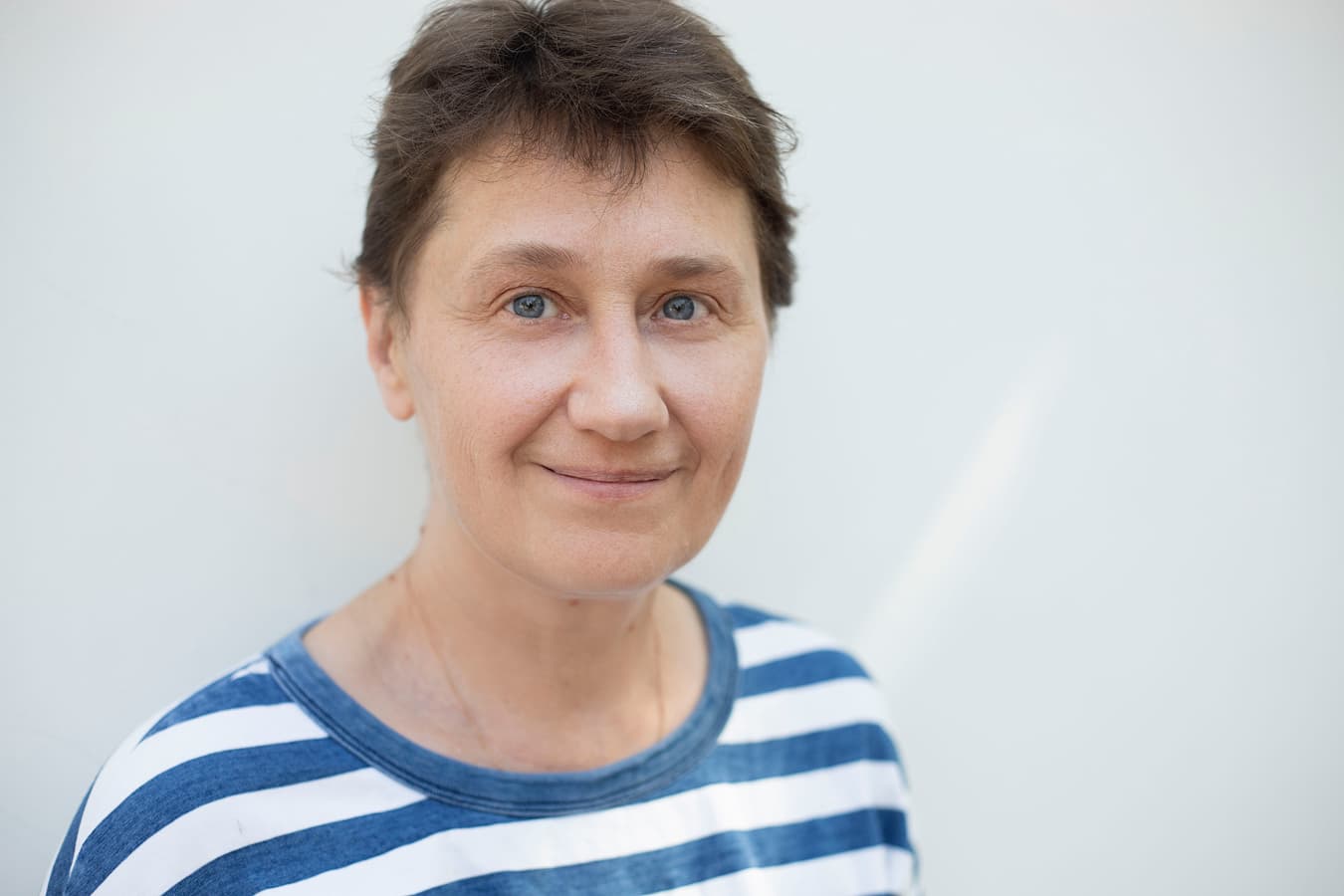
Casting Director Nataliia Borovykh
-
— Nataliia, tell us, what did you dream of becoming as a child?
- I dreamt of being so many things. That’s childhood for you! So many fantasies! There were many different professions among my family and relatives: a medic, a merchandiser, a pastry chef, a cook, a law enforcement officer, a train conductor, a city party committee worker, factory workers, and military personnel. In our family, it was customary to gather for every holiday. I always looked forward to these celebrations because among all the relatives, I liked the men in uniform the most. Probably because of the time — films about the military and heroic deeds were everywhere. There was a sense of romance and heroism. It’s hard to explain now why that appealed to me. From the age of 10, I played handball and dreamed of joining the strongest women’s team in the Soviet Union — Kyiv’s “Spartak.” But unfortunately, I wasn’t accepted due to my eyesight. After that, I dreamt about many other professions. At 14, I wanted to become a forensic expert. At 16, I ended up in a theater studio. Nothing suggested such a turn of events. I guess that was the starting point. That’s how my friend (with whom I used to play handball and shared dreams of a sports career) and I entered the magical world of theater. She became an actress, and I — a theater director. Then the Soviet Union collapsed, people stopped going to theaters, actors had to take side jobs just to get by. Chaos began. I was completely lost. Then, on my birthday, I stood by the window, looking at the pouring rain, and a deep sadness came over me. I was 25, my classmates hadn’t come, it was raining heavily outside. And suddenly, a thought flashed in my head: “If I won’t work as a theater director, I’ll protect actors.” Where did that thought come from? Maybe it was just something that drifted into my mind. And then it disappeared. Later, I entered our theatrical institute to study film. At the same time, I did some voiceover work for computer games and worked as a TV journalist. So all those thoughts about protecting actors somehow faded away. In my final year, our daughter was born. That made me realize I had to earn more — we had rent to pay and kindergarten expenses. Life really unfolds in the most unexpected ways. One day, I was invited to a birthday party for a fashion designer. I really didn’t want to go — it was far, and I had to take my child with me because my husband was working. I hesitated for a long time but eventually went. And that’s where one of the girls asked me if I’d like to work as an assistant on a film project with director Andrii Benkendorf. I thought, “Why not give it a try?” A day later, I got a call and was invited to meet the director. That’s when I found out the job was at the newly opened Film.UA. Andrii Benkendorf was truly my beginning in cinema. I’m grateful to him for everything he invested in me. He taught me through his example. By the time we were working on our second project together, I was already sharing my opinions, arguing. But it was real collaboration. Andrii Benkendorf — director, Halyna Ostrova — second director, and me — this kind of rookie among professionals. Whenever I think of those times, I thank God for bringing those people into my life. And thanks to Andrii Oleksandrovych and Halyna Vasylivna for their patience and for teaching me the profession. It was the most generous gift of fate. That trio — Benkendorf, Ostrova, Borovykh — worked on every project directed by Andrii Oleksandrovych.
-
— So that’s how your career as a casting director began?
— Back then, the profession was called assistant director for actors, because no other position existed. That beautiful phrase “casting director” came later. You know, being a casting director today mostly comes down to constant phone calls, messages, arranging auditions — but that’s not what’s upsetting. What’s upsetting is that, with rare exceptions, casting directors no longer collaborate with directors — they follow producers’ instructions. A casting director today isn’t seen as a cocreator with the director. It’s more of a technical function, since the final say in casting depends not so much on the director’s or casting director’s experience or expertise, but on the preferences of producers and TV channels. And they mostly care about “media faces” (I hate that term — it’s misleading), ratings, and future sales. What’s the solution? I don’t know. We’re all working within the framework of producer-driven cinema and TV production. There are exceptions — in arthouse films or sometimes in feature films. But I realized I was no longer interested. And I couldn’t figure out what to do next. Then, once again, everything resolved itself. It was around 2006 or 2007. Les Serdiuk suggested I work with him as his agent. And that’s how it started. Slowly, I began “gathering” actors, and before I knew it, I had become a talent agent.
-
— Did you become an agent remembering the promise you made to yourself on your birthday to protect actors?
— No, I’d completely forgotten about that promise! That was back in 1991! Who remembers what flashed through their mind then? I actually only remembered it about 3–4 years ago. I was standing by the window. It was autumn. A downpour. That green melancholy. Exactly like my 25th birthday. And suddenly, I remembered everything — down to the tiniest detail. That day, those thoughts while standing at the window in the pouring rain. Saying I was shocked would be an understatement. But it made me feel strangely joyful. Because it means miracles happen. And desires or dreams really can become reality. It’s an amazing feeling. Can you imagine? After 15 years, something that flashed through my mind actually came true.
-
— Do you prefer working as a casting director or as an agent?
— I don’t work as a casting director anymore — all my time is devoted to being an agent. I have a lot of actors. Different ones. But the most important thing is that all of them, without exception, are talented, and I believe in each one of them. Without that belief, I couldn’t do this job. Of course, sometimes I get mad at them or say something harsh. But that’s just part of it…
-
— What’s the first thing you pay attention to when choosing actors to work with as an agent?
— That’s not quite the right question. I don’t choose — the actor does. Then I meet with each one personally. I ask the questions that matter to me. I look into their eyes and analyze. Then I try to imagine: could I direct a play with this actor? If the answer is yes — we work together. But I also believe every actor should choose their own agent, not just go with someone who was recommended. Ideally, an actor should meet with several agents and pick their person. Working with an agent is a long journey, and mutual understanding is crucial. What suits one person might not suit another at all. By the way, I’m not at all interested in an actor’s media presence. The only thing that matters to me is professionalism. I love working with unknown or little-known actors. That’s where the challenge lies — getting the world to notice them. And it’s very rewarding when it works out.
-
— Are your relationships with actors strictly professional or more friendly?
— I’d say friendly, but with distance. I prefer not to mix friendship and work. I have a trusting relationship with my actors. But there’s one “but”: either we move forward together, or we part ways. I don’t do “in between.” I once read a quote from a theater director: “I prefer to work with a less talented but more reliable actor.” I can’t vouch for the exact wording, but the meaning is accurate. My approach aligns with that. From time to time, I reassess my relationships with actors — we decide whether to keep going together or part ways. Usually, when someone leaves, someone new comes along. What’s important for me is that we’re on the same page — in how we think, view life, creativity, and professionalism. It’s very strange to me when an actor wants to work with me just because someone “recommended Borovykh.” I’ve said it a million times — find YOUR agent, not someone recommended by fellow actors. What works for one won’t necessarily work for another. And don’t expect your agent to solve all your problems. The most an agent can do is promote and propose you. The rest — that’s your job. The agent won’t pass auditions for you. Please don’t think of an agent as a superhero who will suddenly bring you auditions, roles, and huge fees.
-
— What’s your favorite project you’ve worked on?
— Oh… there were so many, I can’t pick just one.
-
— If you could have a superpower, what would it be?
— I don’t need that at all. Speaking about the profession, I’ll always advocate for professionalism. People who work in TV, theater, and film are involved in shaping public ideology. That means they’re responsible for what they broadcast on stage or screen. Unfortunately, the level of responsibility is approaching zero — if not negative. I won’t even start listing what’s being thrown at us from screens and stages instead of educating the audience. The concepts of good and evil are being twisted. And it doesn’t matter whether it’s intentional or due to ignorance — the consequences are already visible, and they’re not encouraging.
-
— Thank you. Now imagine you caught a goldfish — what three wishes would you make?
— A goldfish isn’t really my thing. I don’t believe in that kind of magic. I believe in something else: when you truly want something, and that desire is creative and constructive, it will eventually come true. On the other hand, I can’t deny that each of us has a certain role to play — one we must fulfill in order to move forward in our development.
-
— What do you want in life?
— I don’t even know. I have everything I need. Of course, I’d love for the global hysteria that’s been ongoing for the past two years to end as soon as possible. That would be enough to make me completely happy.
-
— Tell us about your hobbies. What do you dream about?
— Hobbies and dreams. Interesting question. Like anyone, I want to relax and only do things when I’m truly in the mood. I dream of a small house, far from civilization. A place to escape to when I need a break from the chaos. When I’m in the mood, I love to cook. Actually, I love doing everything when I’m in the mood. It might not be entirely right, but that’s how I am.
-
— What advice would you give to actors?
— I’m not one to give advice. In any profession, there’s one key — mastering it. Study the profession you chose. Learn the technique of acting. Without knowledge and the ability to apply it, nothing will work. And believe it or not, there is such a thing as safety technique in acting — just like in any other job. In my opinion, raw emotional outbursts aren’t enough. Tearing your soul apart, damaging your psyche, and staying in a broken emotional state after a role — how long can your body take that? What about your mental health? It won’t end well! If you weren’t taught this in school, figure it out yourself! It’s not that hard. Study global acting traditions. Read. Experiment. Find your own ways of creating a character. Let’s be honest — not everyone thrives with Stanislavski or Chekhov. And that’s okay. Every actor has their own path in this profession, based on knowledge and their personal heroes. Please remember: your value lies in your individuality. Don’t try to be someone else. You weren’t made on a conveyor belt. Be yourself. Develop your uniqueness.