Casting Director: Masha Pikalova
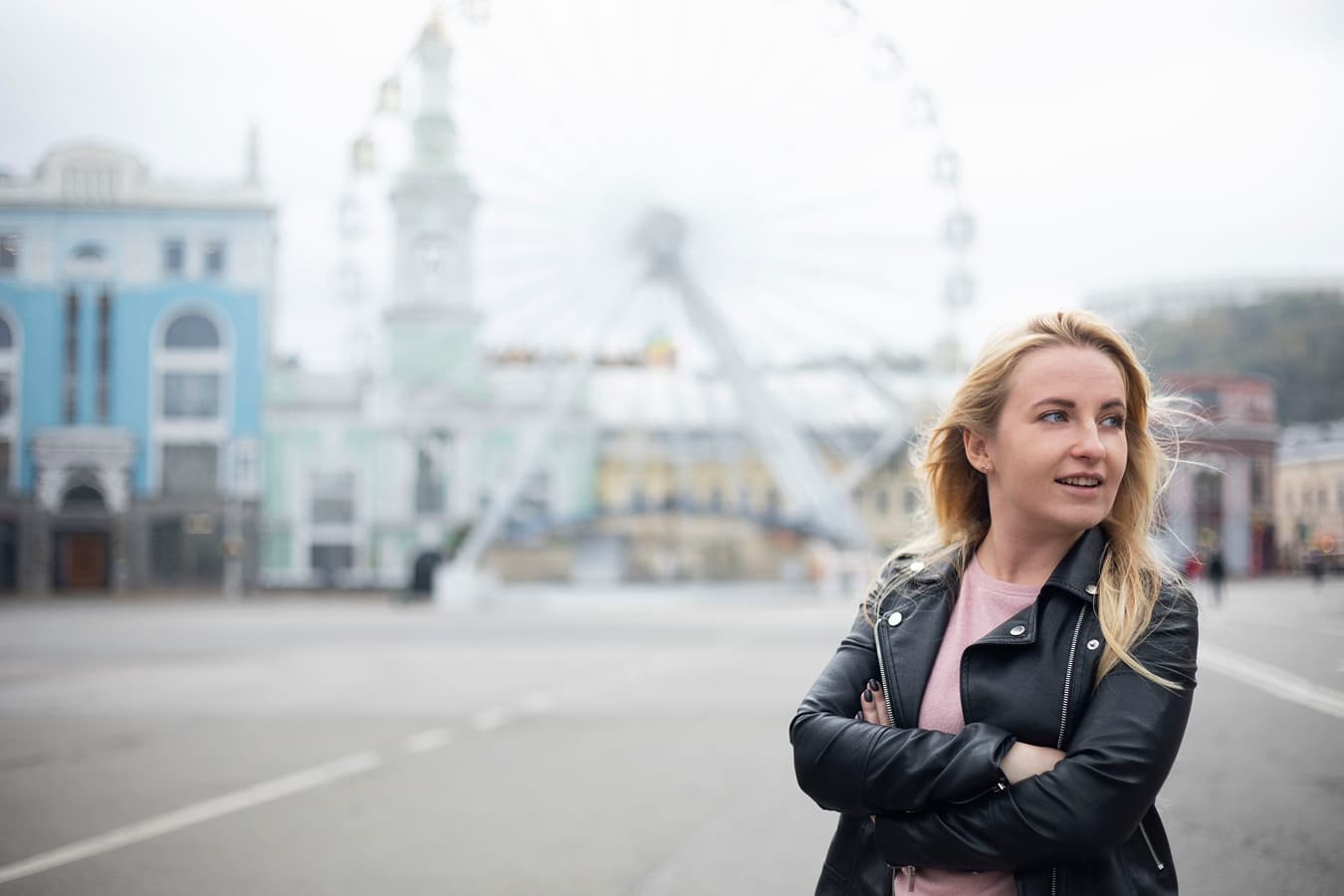
-
– How did you enter this profession, and how long have you been working in it?
– I entered this field in a rather unusual way. I graduated from the acting faculty in Kyiv, then stayed on to teach acting there. Later, I moved to Kharkiv and worked for a year in a bureaucratic system that was quite dreadful. Eventually, I returned to Kyiv and visited a friend who was working at the “Ukraina” TV channel. It turned out that the girl conducting auditions had fallen ill, and their casting director, Sasha Pylypenko, was overwhelmed with work and unsure of what to do. They suggested me as a replacement. I agreed, conducted the auditions, and Sasha asked, “So, would you like to stay with us?” That was the beginning of my journey. I’ve been working in casting for over five years now.
-
– Have you had a favorite project during this time?
– I have mixed feelings about our casting industry, so I no longer take on serial projects. The first reason is that I don’t enjoy doing things that are straightforward and simple. I could easily handle any series now, but it’s no longer interesting to me. Of course, there are more and less complex projects, but overall, I’m familiar with the actors and the process. Money and stable work aren’t my goals. Currently, I’m involved in photo castings and model searches, as well as short films for German director Harold Franklin.
The second reason is that our serial production isn’t well-developed in terms of human relations. It’s important to me that after a project involving my participation —as I represent the production—I don’t feel ashamed in front of people. The human attitude towards actors and the process isn’t always acceptable to me.
-
– Were there any special short films among these?
– Yes, Harold writes very interesting scripts. It’s a completely different world when one person is the client, producer, and director. In our production, there are always deadlines, small budgets, and everyone is nervous. But he’s all about the art. He can afford additional changes or actors if he likes them. It’s much more interesting and very unusual. During the first days of shooting, I was surprised that no one was rushing: we’re losing time, there will be overtime! But then I realized—for him, quality is more important than quantity. His approach is: okay, there will be another shooting day, I’ll pay for it—the main thing is that everything is done well.
He shoots here as well. He works with various actors: some from neighboring countries, and a few favorites he works with regularly. We might have filmed all our actors, but there’s a problem: 80%, even 90%, of actors don’t know English. I doubt that anyone I informed about their insufficient language level went on to improve it. They understand that the production is large, and roles will still be available. But I think it’s interesting to work on oneself and participate in something entirely different.
Sometimes Harold has roles in German. If he liked one of our actors but realized they couldn’t handle English, there were instances when he added a scene set in Ukraine and wrote lines in Ukrainian.
We’ve been collaborating since last spring. Before that, in early autumn, I decided not to engage in serial production anymore. Then, foolishly, I was approved for a linear role in a series—I filmed there for three to four months. And then Harold’s projects appeared. I rarely look for work—projects find me themselves.
Simultaneously, I’m involved in photo selection of models. It’s a completely different market. Everyone I shoot here would never be cast in a series, and vice versa. There are different requirements and preferences.
-
– What exactly are these differences?
– In serial production, there’s a concept called format. People are afraid to take risks and usually choose, as I call them, people with “egg-shaped faces”: those without anything extra. But in photo shoots, you can photograph people as they are in life: with braces, without teeth, without an arm, with freckles, with a crooked nose. Also, in photo shoots, I don’t care how the model speaks. When I still worked in series, there were several attempts to cast someone, even in an episode, who lisped or had a speech impediment—because such people exist in real life—but no one agreed. Another problem is when you photograph some actors, they start to act. There are those whose “folkness” can’t be removed, unfortunately. Now I often engage in street casting: I can walk down the street, see someone I like, and offer them a shoot.
-
— How do people react?
– Most often, they laugh. They probably don’t believe it because it’s not customary here. We talked with casting directors from Europe: they often find someone and develop them, discover a star. Here, people prefer to go the tried, reliable, same path.
-
– Have you discovered any actor or actress?
– I really like Yaroslav Shakhtorin. He impressed me when I was recording auditions at “Ukraina” with Pylypenko. He was in his first or second year then. This is a child who organically and honestly switches between polar emotions. He has enormous potential—the main thing is that our industry doesn’t break him. I also worked with Zhenya Lebedyn. I met him when he was 8 years old. I don’t know how such a wide range and such maturity can fit into a small child. He works better than 50% of adult actors. I have many favorite actors. I still go to theaters because you can see more there than in series. In the theater, you see a real actor. At the Franko Theater, for example, Koshkina works wonderfully. You believe her completely. I think she’s underrated in cinema. She already has short films, but perhaps the directors and projects that would suit her haven’t appeared yet. She’s great—she doesn’t agree to work just for money; the idea, the concept, what she plays are important to her.
Unfortunately, when many talented actors don’t succeed for a long time, they give up and go to work somewhere else. And it’s not because they’re untalented or not up to par—they just weren’t noticed, or people were afraid to take a risk, or for other reasons.
-
– Do you feel fear in your profession?
– No, I’m not afraid of anything. It’s just work. If I don’t like something, I can always leave. The only thing is—if I’ve already agreed to a project, I won’t abandon it, no matter how difficult the situation is.
-
– Do you ever worry that an actor might not show up or that something might happen to them?
– It happens. But it’s not fear—it’s the human factor. In this profession, no matter how well you do your job, you depend on a large number of people. Even if an actor doesn’t show up (I no longer work with such people), I know how to quickly solve the problem, how to find a replacement. It’s a stressful moment, but understandable. I try not to work with actors I’m not confident in. It’s not about personal acquaintance. For example, it’s unlikely that someone with a specialized education who has acted in certain projects would act that way. If something like that happened, everyone would know—it’s a small circle: everyone tells each other about such things. If the situation is serious, I can write to Sasha Pylypenko or familiar casting directors and ask if they know this actor, if they’re adequate. But there are other factors, for example, when the shift is organized, people arrive on set, and the location isn’t aware that filming was supposed to happen there. And then you have to explain to the actors that the shoot is postponed, and, as always, there’s no money to compensate them for the trip. You have to find replacements for scenes, call those who weren’t supposed to shoot today, persuade them to come because the equipment is ordered, and the shooting day can’t be canceled. You have to find a new date for the actors whose shoot was disrupted. It’s very energy-consuming and nerve-wracking. And all because one person didn’t call or didn’t arrange with the location.
This is one of the reasons why I said goodbye to series: short films and photos aren’t as stressful. I take everything very personally; I’m hyper-responsible. I’m always embarrassed that I might let people down, even if it’s not really my fault. Now I’m trying to teach myself that this is just work; it’s not the meaning of my life, not my health, not sleepless nights, and not illnesses due to nervous breakdowns. In cinema, there’s a rule: when a problem arises, it needs to be solved first, and only then should the culprit be found. But unfortunately, that’s not always the case.
-
– What did you dream of becoming as a child?
– I studied at an arts lyceum with a focus on theater from a young age. People always told me I should become an actress. I always knew my life would be connected to creativity in some way. I’m a humanities person through and through. At university, we were constantly told how terrible and frightening this profession is: “you won’t have friends here,” “you have to destroy each other,” “you’ll never have a family”—everything came with pain, tears, and a broken psyche. Now I understand that this was a primitive mindset and that things can be different. But back then, they constantly put us through hardship and tough experiences. After my third year, I played a difficult and very mature role in our graduation production “Talan” about Mariia Zankovetska. I weighed about 37 kg afterward. It was intense—you’re constantly giving all of yourself. That summer, I thought: if things really are the way they say, then I don’t want this. I don’t want to backstab or undercut anyone. I didn’t drop out of university, but I realized I wouldn’t become an actress—because human values and principles matter more to me.
-
– Do you have any hobbies?
– Recently, I discovered I can actually draw. I’m trying to explore different techniques and reset my brain—to unlearn how we were taught to draw “correctly,” because the truth is, it’s not like that. I love animals. I have two rescued cats and one dog from a shelter. I try to feed stray animals when I can. If I see one in need, I have no problem taking it to the vet.
And recently, I stole a cat from a restaurant. I was rushing to work and saw this little kitten—three-colored, about two months old, with a collar. I picked it up and saw there was an address and phone number. I called, but no one answered. So I called my friend: “Yehor, I’m bringing you a cat. If the owners get in touch, you’ll give her back.” I got there and saw a ton of Telegram messages: “Are you sane? Did you read the address?” I googled it—turned out it was “Chornomorka” (a seafood restaurant). I had to call and admit: “So… I have your cat at home. I’m just a city crazy person who thought she was lost.” The girl laughed and thanked me for caring. The kitten is still small and often runs off.
I enjoy cooking. Lately, I’ve been completely in love with Pan-Asian cuisine and I’m trying to master it. I made ramen once—never again. Just the broth takes six hours, there are tons of ingredients, and the entire apartment smells awful. Maybe it’s worth it for a big family, but not for two people. But noodles, rice, curry—I make those all the time. Of course, I can also cook carbonara, Olivier salad, borscht—no problem. I just realized that our generation didn’t grow up with a culture of food. The goal of food was just to be full. Even our soups are loaded with potatoes, grains, root vegetables. But in Pan-Asian cuisine, not everything in the soup is meant to be eaten—some ingredients are just for flavor.
I recently stopped eating meat. Not strictly—if I need to, I will, but I haven’t felt like it. I prefer fish, seafood, and vegetables now.
-
– What do you read? Do you have a favorite book?
– The Little Prince by Antoine de Saint-Exupéry. I reread it at least every two years. I have a special relationship with that book: even though I know it by heart, every time I read it, I find answers to the questions that are troubling me at that moment. I think it’s magical and absolutely not a children’s book.
I love detective stories—but only quality ones. Agatha Christie is probably the best in the genre. When I want something lighter, I read Akunin. But overall, I prefer the classics. I enjoy poetry too.
-
– What about films?
– I have many favorites. Nowadays, there are far more quality TV series than films, and they’re more convenient to watch. From the classics—I often rewatch Friends. If I don’t know what to put on, I just start any episode.
Recently, I really liked The Haunting of Hill House on Netflix. My favorite genres are horror, thrillers, and detective stories. I really dislike dumb comedies. Comedy is hard—very few people can do it well. French ones are sometimes okay, but the American ones—about bananas, butts, and boogers—I can’t stand them. I don’t like the actors in those films either. It’s uncomfortable to watch when someone overacts or mugs too much.
Lately, I’m not into dramas either—life already has enough of that. As a teenager, I could cry over a film, but now… If it’s a social topic—sure. But love stories and heartbreak? No, thanks.
-
– What do you dream about?
– I want to start doing something of my own. When it’s your own project, the only person you can blame—or praise—is yourself. There’s no abuse of power in that kind of structure. Yes, mistakes happen, but you fix them and move on. When I’m older, I really want to open my own café. Maybe in my own house—if I ever have one. No fixed menu—just a daily menu, so people know: it’ll be delicious.
I want kids. A lot of them. And I want to always keep the desire to try something new. I never want to reach that point of stagnant stability—“I don’t like it, but at least it’s a job.” I don’t want to grow old inside. I want to feel joy and inspiration regardless of age.
-
– What advice would you give to our actors?
– Work. Don’t be lazy. Actors often say: “I really want this. Tell me how to get to those castings.” But what have you actually done to find them? There are basic Facebook groups for castings—join them, look through the members, add them as friends. Some people won’t even take that step.
Another issue: actors who are already fairly well-known and well-paid, with stable jobs. But that’s no excuse to stop growing. I’ve talked to many actors, including foreign ones. Their mindset is different: if they have a day off—they work. If they don’t get a role—they try to understand why and improve.
Sometimes you’re not cast because they want a different type. But sometimes they do want someone like you—but not you. Maybe the issue is in your diction, your appearance, or your behavior. In our industry, no one really teaches you how to properly film a self-tape or attend a casting. People send videos with pots and pans in the background, wearing white tank tops at home, in bad lighting. I can’t approve someone based on a tape like that—unless I’m casting a drunk guy for one line.
Watch your video—do you even like how it looks? And don’t be ashamed to ask why you weren’t chosen. A good casting director will answer. The main thing is: keep growing. And don’t assume anyone owes you anything. Half the country wants to be an actor and get cast. Be realistic about your abilities —and work on yourself.