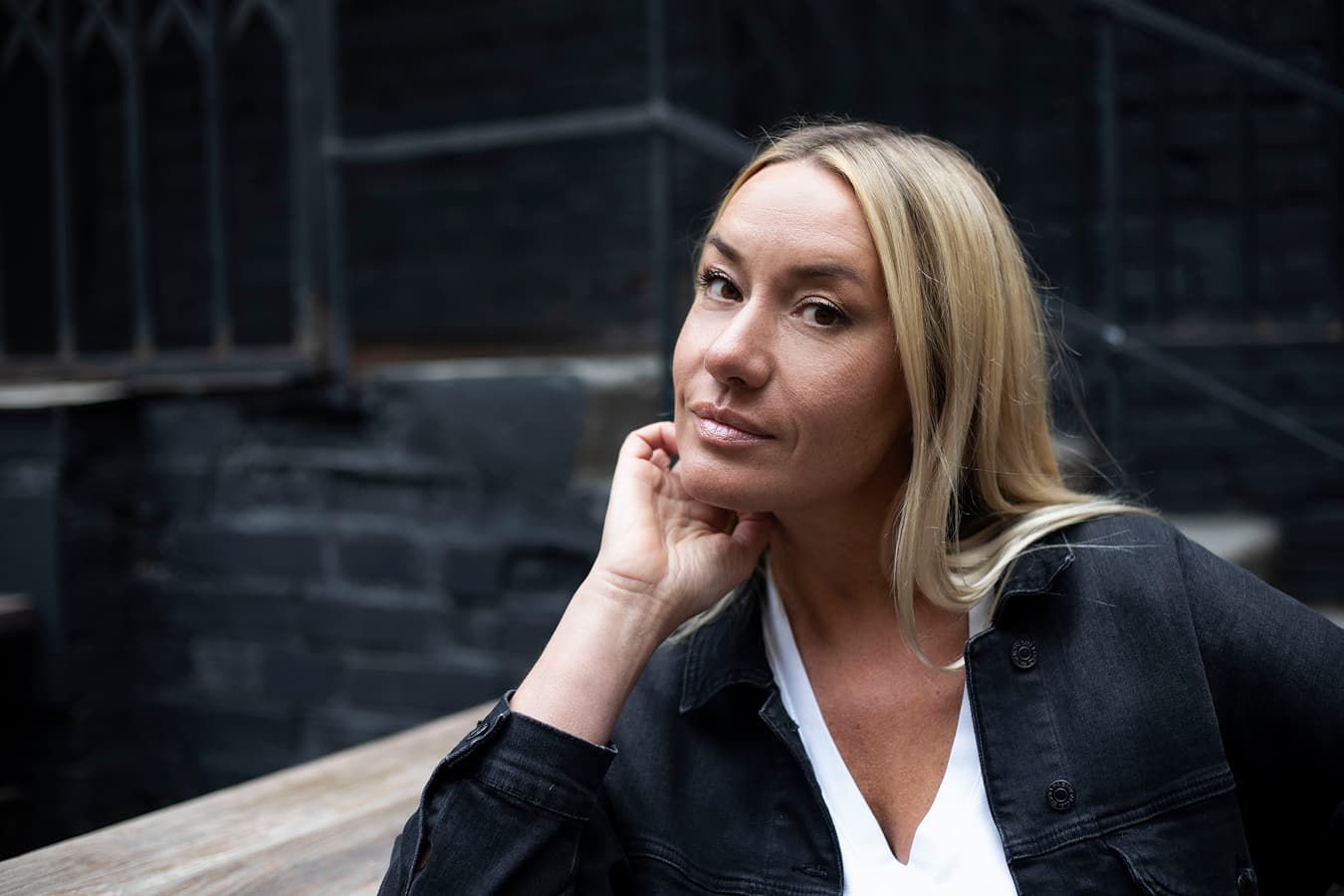
Casting Director Irma Tzareva
-
– How did you come into this profession?
My path has been rather unusual. I’ve changed professions several times, and I believe casting might not be the final stop. I have a degree in economics and used to run a construction store—I was the chair of the board, managed a team. But then came a moment when I realized that commerce was definitely not for me. I managed to change my life and started as an intern at the advertising agency Stairsfor, under Mykhailo and Tetyana Ilko—progressive creative professionals with an artistic background. I was very lucky: for six months, I wasn’t allowed to work with clients—I studied books on art, photography, marketing, and advertising. At the time, the agency had an amazing library. I completed test tasks, and at the end of each workday, Mykhailo would talk about new trends and work methods based on European practices. Back then, I didn’t understand it—I found it boring, strange, and unnecessary. I just wanted to dive in, to take action!
When Mykhailo saw that I had a solid knowledge base, I started interacting with clients. It was an exciting time when advertising in Ukraine was just beginning. I started working with the first production houses, found myself in a creative environment. Stairsfor eventually became the creative department for Eurovision 2005. The agency helped develop the concept for the festival, from stage design to all accompanying materials. Mykhailo and Tetyana gave me invaluable experience, taught me to see, and nurtured my artistic taste.
I began working with photographer Taras Malyarevych as his assistant and producer. This eventually evolved into our own small production company. We worked in advertising, and I handled organizing photo shoots, finding teams, locations, models, and actors. Later, we opened a photography school where nowprominent talents like Serhii Sarakhanov, Dmytro Bohachuk, and Anton Tkachenko started their journeys. I was the school’s creative director. Photography knowledge is a great foundation for casting. I adore photography as an art form—I even shoot myself.
That’s how I got into film. My “cinema godmother” is Tetiana Tatarenko, a brilliant, talented makeup artist with vast experience. She worked at Dovzhenko Film Studio and collaborated with us on commercial projects. In 2011, Oleksandr Ihnatusha’s film “Mom, I Love a Pilot” was in production. On Tanya’s recommendation, I was hired as a props assistant on set—even though I had no film experience—to work with production designer Inna Bychenkova. Being in the art department, I became fascinated with cinema as a whole. I was curious about how everything worked, quickly built rapport with the crew and actors, and have now been in the industry for over nine years.
I joined Volodymyr Saveliev’s film “On the Edge of the Abyss” at Dovzhenko Studio as a photographer. Casting was handled by Mykola Vasylovych Fedyuk. I took portraits of actors in costume and makeup—since it was a historical film with characters like Stalin, Beria, and members of the politburo during the Cuban Missile Crisis. It was a complex job alongside the makeup (Tatiana Tatarenko) and costume (Yulia Hlemeida) departments. I learned a lot from the Masters at Dovzhenko. Gradually, I became involved in casting: I suggested actors, participated in auditions and filming.
A great casting school for me was the TV channel 1+1, on the series “Cops Wars.” Sometimes, walking the corridors of the studio, I thought I would faint—the information overload was overwhelming! It’s one thing to work on short films or features, but another to dive into the pace of a series with a huge number of roles. It was a tough school. I had to find actors quickly with low fees, navigate complicated filming schedules, and respond rapidly to constant changes. I’m grateful to casting director Oksana Stepchuk, my boss at the time—she taught me a lot. In just a year, I gained invaluable experience in series production and met many actors.
My next project was the historical feature “The Secret Diary of Symon Petliura” by director Oles Yanchuk, shot in Kyiv and Lviv. It was quite challenging: casting was based on portrait resemblance to historical figures. Only Honored and People’s Artists appeared in the film. Working with such actors requires a different approach and communication style. I had no assistants—I was the casting director, manager, and on-set assistant all in one. I also had to study Ukrainian history more deeply and work with archives.
Most recently, I finished another historical project—“Carol of the Bells”—written by Kseniia Zastavska and directed by Olesia Morhunets-Isaienko. It’s now in postproduction. The children’s casting was long and complex. The director had high standards. We needed children who could play their characters at two different ages—there were four of them. Add to that the ensemble, resemblance to onscreen parents, nationalities (Ukrainians, Poles, Jews, Germans). The roles were major, with lots of dialogue and daily shooting—and the kids were just 7-8 years old. The lead role was brilliantly played by Polina, daughter of Dasha Trehubova.
-
– Which other actors did you discover? Which project touched your heart?
Artur Lohai is a great emerging talent, and now his career is skyrocketing. When we met, he didn’t even have a proper portfolio. He had acted in a few projects, but they hadn’t been released yet. That’s always a risk for casting: when an actor says, “Yes, I’ve worked, but there’s nothing to show,” you don’t know how they’ll perform day after day. It’s one thing to play an episode—another to carry 24 episodes as a lead. It took some effort to convince the producers and director, but we did it—and Artur nailed the role.
The film “On Sunday Morning She Gathered Herbs” was life-changing. When I first read the script, it reminded me of Latin American telenovelas like “Wild Rose” or “Slave Isaura.” A melodrama! A young Roma girl falls in love, the baron is against it, they want to marry her off, she has a child, they try to kill her… and then —bam!—20 years pass. The same actress had to play herself at 16 and 36. In a feature film, you’d cast two actresses, but in a series, you can’t—viewers might switch channels. When we started shooting, the film turned out so warm and heartfelt thanks to director Oleksandr Tymenko (“Catching Kaidash”) and the authentic Roma energy. I met the brilliant artists from the Roma theatre “Romance” —Ihor, Lyudmyla, and Zhanna Krykunov—and we’ve stayed friends since. The Roma are truly magical: many of us who worked on this project felt our lives change. People quit bad habits, rethought their paths. The film had very high ratings—it became true folk cinema.
-
– What do you dream about?
I’ve realized I’m good at connecting with people. Many tell me they feel inspired after talking to me. I’d like to keep nurturing that quality—whether in casting or something entirely different. You often ask actors what they fear in this profession. I have no fear about not getting the next project anymore. That’s in the past. There were times when I went six months without work. So, dear actor friends, when you write to me: “Do you have any projects for me?”—remember, I might be waiting for offers too. I’m a freelancer—projects don’t fall from the sky. Sometimes I see a call from an unknown number and think, “Okay, I’ll wait three rings before answering, take a breath, and say ‘Hello?’ all nicely.” And then it’s a bank. Another letdown. In this, we’re in the same boat. I’ve worked through those fears. Now I understand that if there’s no new project, maybe the universe is redirecting me somewhere I’m more needed. I’m open to something new—even if it’s not casting.
-
– Were you ever an actress yourself?
I’m quite a shy person—though you might not guess that now. People say that makes for good actors. But there’s an ethical issue: when a casting director takes a role in a project they’re casting, they’re taking that opportunity from someone else. Even the smallest parts should go to those who train and devote their lives to acting. I did have one acting debut—just two lines—but I broke into a sweat. It was a great experience. It helped me understand how actors—especially new ones— feel. Now I know how to support them during auditions and create a friendly, relaxed atmosphere on set.
A colleague once sent me a script and suggested I self-tape. I guess they liked my type. But the whole scene revolved around this character. I asked: “Are you sure? I’m not an actress.” I knew I wasn’t ready to carry a scene. As a casting director, I understand what every ruined take costs, how tightly filming is scheduled. It’s not the place for experimentation.
-
– What did you dream of becoming as a child?
No one! (laughs)
– What kind of childhood was that?
– A great one! But I had no dream job (hello to Mikh Mikh from FILM.UA School— he brought this up again). Every summer I visited my grandma and ran a neighborhood kids’ theater. And guess what? There were Roma kids there too! I directed plays—everyone wore scarves, sang songs. We had curtains strung between trees, neighbors brought their chairs to watch. All year, everyone waited for “that girl from Kyiv” to come back. I guess I should’ve gone to film school.
I also really wanted to play the piano—like my childhood friend, now costume designer Katya Lytvynova. Her teacher came to her house, and I’d sit nearby, listening and watching, so jealous. My mom said it was impossible—we were a military family, always moving, we couldn’t haul a piano around. But I finally got one—not long ago, as a gift. I took lessons and learned to play some simple pieces—until the neighbors started banging on the walls. Now I just quietly improvise when no one’s home. There’s still a musician living inside me. -
– And finally…
I’d love to spend more time in acting schools. People often ask for recommendations, and I can’t give them if I haven’t seen the process myself. Mikh Mikh at FILM.UA School really impressed me—a true Master. Talking with him makes you reflect, rethink your values, motivates and inspires. I want to meet more creative, talented people, get to know teachers and actors better. I dream of working on a major project with a fresh, modern script—something that allows me to cast non-typical, unique, authentic actors. And I still really want to do a musical. I guess that’s the dream. At least for now.